I have created a number of videos that explain what is going on when a calibration is being performed. Go to the resources page (link above) to watch these.
But here are the basics.
A calibration is done to gather the characteristics of the transmission so it can operate afterwards. There is a lot of information that needs to be gathered about sensors (distance, pressure sensors), control devices (solenoids) and how these affect the transmission components like pressure, clutches and shift rods.
Each sensor is an output device and nothing more. There is no programming of any sensor. The TCU simply goes through many functions of the transmission and gathers the information required so it can operate later. More information is stored afterwards when driving, and adaptations will be constantly gathered by the TCU during all operations during the lifetime of the vehicle.
There are two types of calibration.
1. Calibration after parts replacement. I call this the “long cal”.
2. Calibration without previous parts replacement. I call this the “short cal”.
The long cal has 5 separate routines:
A. Programming of the TCU. This is where the previous calibration data and adaptation data is deleted.
B. Pressure sensor calibration.
C. Shift rod calibration. This is where the distance sensor data is collected. It is also where all the valve body information related to gear shifting is collected.
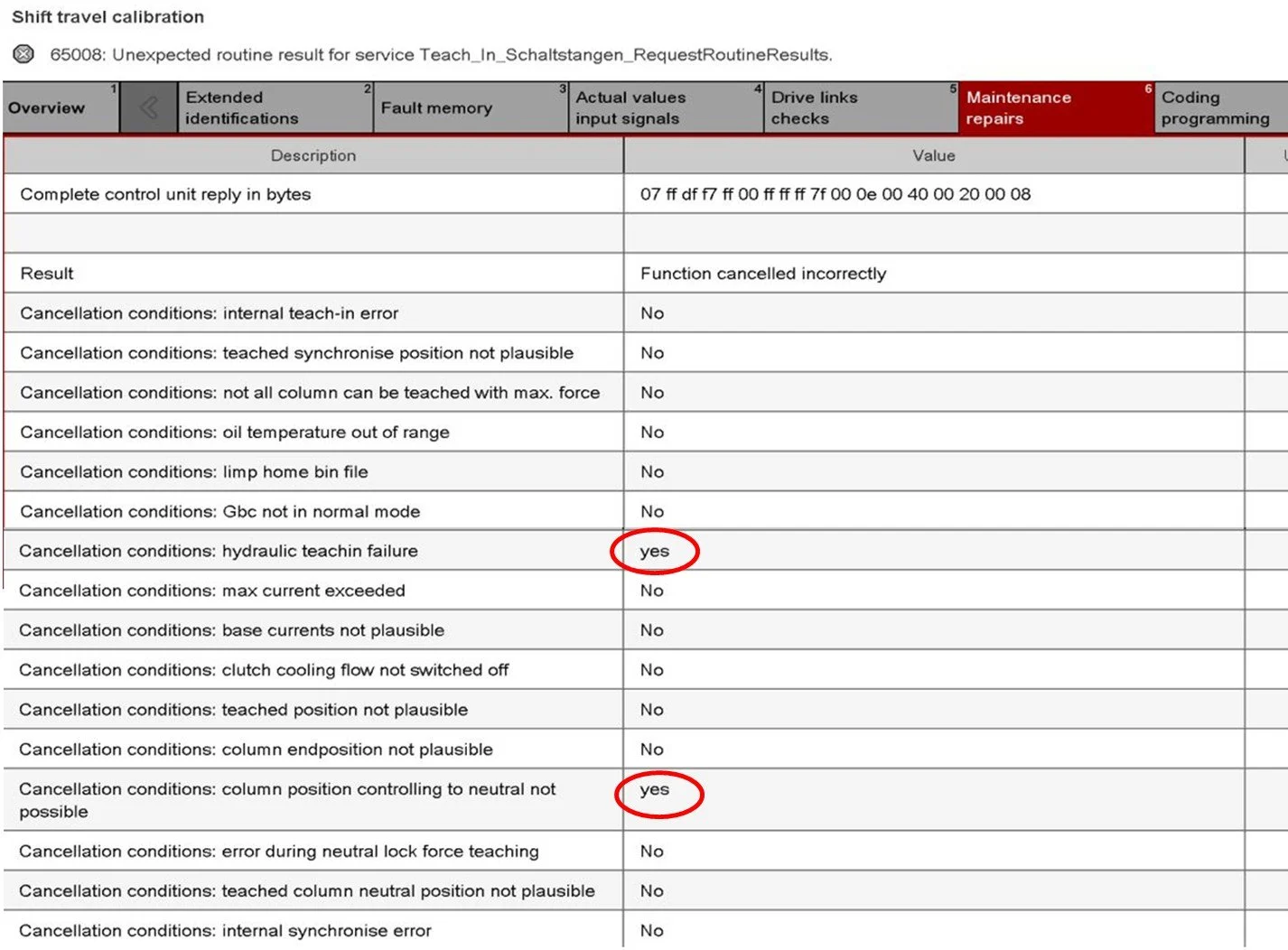
D. Hydraulic teach in. This mainly deals with emergency functions of the valve body. It also gathers some information about clutch valve operation. Unfortunately this routine is very prone to failure.
E. Clutch calibration.
The short cal only carries out routines C and E.
If you have replaced the distance sensor then only the short cal is required. Do NOT conduct the long cal.
Important information to understand.
Even if the car is driving fine without conducting the calibration, for a number of technical reasons it’s important to conduct the calibration after a distance sensor change. In simple terms the TCU will be using the outputs from the previous sensor for all operations, and these will be different to the new sensor. Even if the car seems to be driving perfectly OK, the way the TCU is engaging gears will not be optimised, which may lead to increase wear and a reduction in transmission self protection.
The calibration routines are in the TCU, not PIWIS or other diagnostic program. PIWIS just turns them on and off.
If you attempt a short cal and it fails, attempting the long cal will still fail on the same routine as the individual routines are identical.
BUT, here is the problem.
If you attempt a short cal only and it fails, you can delete the fault codes and it’s like you never attempted it.
If you attempt a long cal and it fails, you have deleted all the previous calibration data, so you must now complete the full long cal successfully to get the car going. Part D can be very problematic and take many attempts to pass.
If you attempt a long cal and it fails, and you consequently attempt a short cal, the most likely result will be as follows. The shift rod calibration will pass (if all is OK) and then the clutch cal will fail immediately it starts. This is because the clutch cal (part E) requires some data from the hydraulic teach in (part D), and this was deleted by part A of the long cal that had been previously attempted.
This means that if you initiate a long cal, you are locked into completing the long cal successfully to get the car working. So unless you definitely need to conduct a long cal due to the work being done, I would suggest you never attempt it.
It has been reported that aftermarket diagnostic tools can brick the TCU during calibration. For this reason I suggest only using PIWIS for the calibration. I personally use the PIWIS 3 that is described on the PDK Pirates website. Link below. I have used this extensively for sensor testing and general diagnostic work. It has worked a charm, cost peanuts to purchase, and is relatively simple to set up.
PDK Calibration information
Getting the long calibration to work
This isn’t guaranteed, but I’ve helped a few people successfully complete the long cal using the procedure below. This may provide a better chance of success.
Have everything setup to begin the calibration. In P, park brake set, stick on brake pedal, a/c off.
Ignition on, but engine stopped. Delete all engine and transmission fault codes.
Start engine and allow the clutch fluid temperature to rise to 40C. Observe this in PIWIS.
Conduct the oil fill procedure in PIWIS for approximately 30 secs.
Once the oil fill procedure has been stopped, continue engine idle and allow the clutch fluid temp to rise to 65 C.
Begin the long calibration.
Calibration failure indications.
Sometimes the calibration fails due to a car network connection problem. The image below shows what you see when this happens.
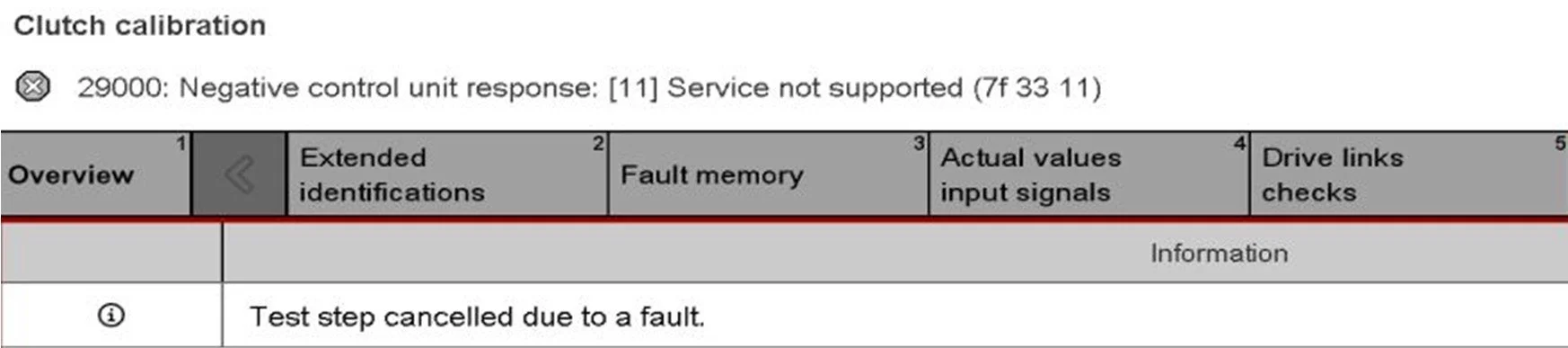
During the calibration routines you will be instructed to turn the ignition off for a time period, and then back on again. The signal for the cycle in ignition should be sent through the car’s network and immediately seen in PIWIS. Note you should never remove the key.
If PIWIS doesn’t immediately respond to the change in ignition status there is also a PIWIS connection problem. If this happens consistently the only remedy I’ve seen work is to change the PIWIS machine being used. Not necessarily changing from PIWIS 2 to PIWIS 3 for example, but just changing the PIWIS computer. It might be the interface or the machine. There is limited information available to determine exactly the problem source. Normally in these cases the ignition status change is being sent across the car’s network, but it’s just not being seen by PIWIS.
If the calibration fails due to incorrect sensor outputs, clutch problem, etc, you will see something like below. It will give a reason/reasons for the failure.