PDK Pressure sensor faults
For most transmissions there are two pressure sensors. One for each clutch circuit, pressure sensors 1 & 2. On the 911 fitted with the active differential there is an additional pressure sensor, pressure sensor 3. If you don’t have the active differential installed, PIWIS will list pressure sensor 3, but the pressure will be zero.
Each pressure sensor receives a 5V power supply from the TCU. This is the same supply as the distance sensor. Each sensor has three wires, 5V supply, ground, and output. The supply and ground are common to all pressure sensors, with an individual output wire for each sensor.
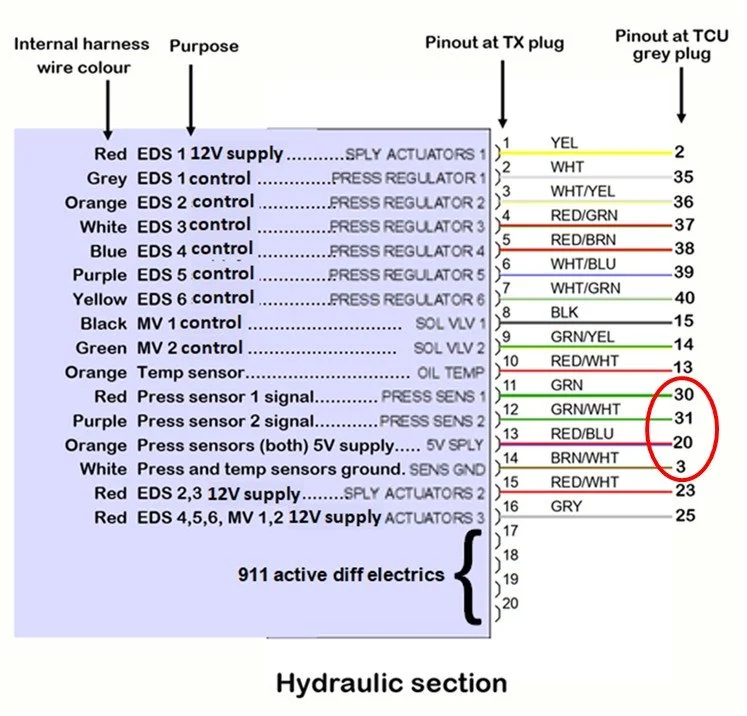
Refer to the wiring diagram below. 5V supply is pin 20. Ground is pin 3. Output is a voltage at pins 30 & 31 for pressure sensors 1 & 2.
Voltage across pins 20 and 3 should always be 5.0V when operating.
As the pressure increases, the output to ground voltage increases, and output to supply voltage decreases, but they still always add to 5V. Some examples are below.
Prior to showing a few examples, here is some background info on what pressures are normal during operations.
The pressure sensors detect absolute pressure. This means that prior to engine start with no fluid pressure, the pressure sensors should read about 1 Bar (about 14.5 psi). Often it’s slightly higher than this, up to 1.2 Bar. If the pressure sensor is reading zero in PIWIS, this means a complete vacuum, and zero output from the sensor, which probably means the sensor has failed.
After engine start with the transmission pump working, the pressure in both clutch circuits should rise by about 0.4 Bar from what it was before engine start. This is the natural pressure that is fed to the clutch circuits with zero intervention by the TCU. You could fully electrically disconnect the transmission and if the pump was turning you would get this slight pressure rise when the pump starts turning.
When you select D or R, but still have your foot on the brake, the clutch that is about to be engaged (clutch 1) will pre-fill. This is getting it ready to be engaged when you release the brake. The pre-fill pressure is normally about 2.8 Bar.
When you release the brake the pressure increases slightly to engage the clutch. The pressure will rise to approximately 3.1 Bar.
The pressure in the engaged clutch will change depending on load. If you are cruising at a constant speed you might see 3.1 Bar, and if you press the gas pedal hard this will jump rapidly, maybe up to 6 Bar so the clutch remains clamped under load and doesn’t slip.
Note that the clutch not being used will remain fully depressurized during normal operation and won’t pre-fill. You should always see approximately 1.5 Bar on the non-engaged clutch.
Live voltage testing examples when back probing at the TCU:
Before start:
pin20-pin3 = 5V. pin20-pin30 = 4.5V. pin30-pin3 = 0.5V.
Same using pin 31 as the output.
After start but no pressure applied at clutch
pin20-pin3 = 5V. pin20-pin30 = 4.4V. pin30-pin3 = 0.6V.
Clutch pre-filled but not fully engaged.
pin20-pin3 = 5V. pin20-pin30 = 4.15V. pin30-pin3 = 0.85V
Clutch fully engaged
pin20-pin3 = 5V. pin20-pin30 = 4.1V. pin30-pin3 = 0.9V.
Measured resistances of the sensors in isolation are:
Supply to signal: 35 MOhm
Signal to ground: 8.1 kOhm.
How do the pressure sensors work?
Pressure sensor faults
There are many pressure sensor faults, and I won’t list them all here. Pressure sensors can fail, but they are difficult to replace. The transmission needs to be removed from the car, and then the clutch pack removed to gain access to where the sensors are installed. This is expensive and time consuming.
Prior to immediately thinking a pressure sensor fault means the pressure sensor needs replacing, diagnostic testing is essential to determine that the sensors are at fault. Sensors do fail, and this may be the issue, but it’s a good idea to do solid diagnosis testing first. Many have jumped straight into changing the sensors only to find this doesn’t fix the problem and they have wasted a lot of time and money.
Here are some examples.
Incorrect interpretation of pressures by the TCU
Back probing of the sensors at the TCU will show if the sensor outputs are correct. There have been instances where the pressure sensor outputs were fine, but it was the TCU failing and interpreting the sensor outputs incorrectly.
No pressure rise after engine start
This will give pressure faults that make it look like the pressure sensors need replacing. If you don’t see a small pressure rise in both pressure circuits after the engine has been started (as described above), this can be due to the pump not turning.
This problem often gives faults with both pressure circuits. It’s highly unlikely that both pressure sensors have failed at the same time, so looking for a common cause is advised in this instance.
This problem of no pressure rise on both circuits can be from the pump gear that engages with the clutch pack failing (it has tabs that engage with the clutch and these can break off). I’ve also heard of more than one instance where the dual mass flywheel failed, with this causing the flywheel to disengage from the clutch pack, and hence the pump wasn’t turning.
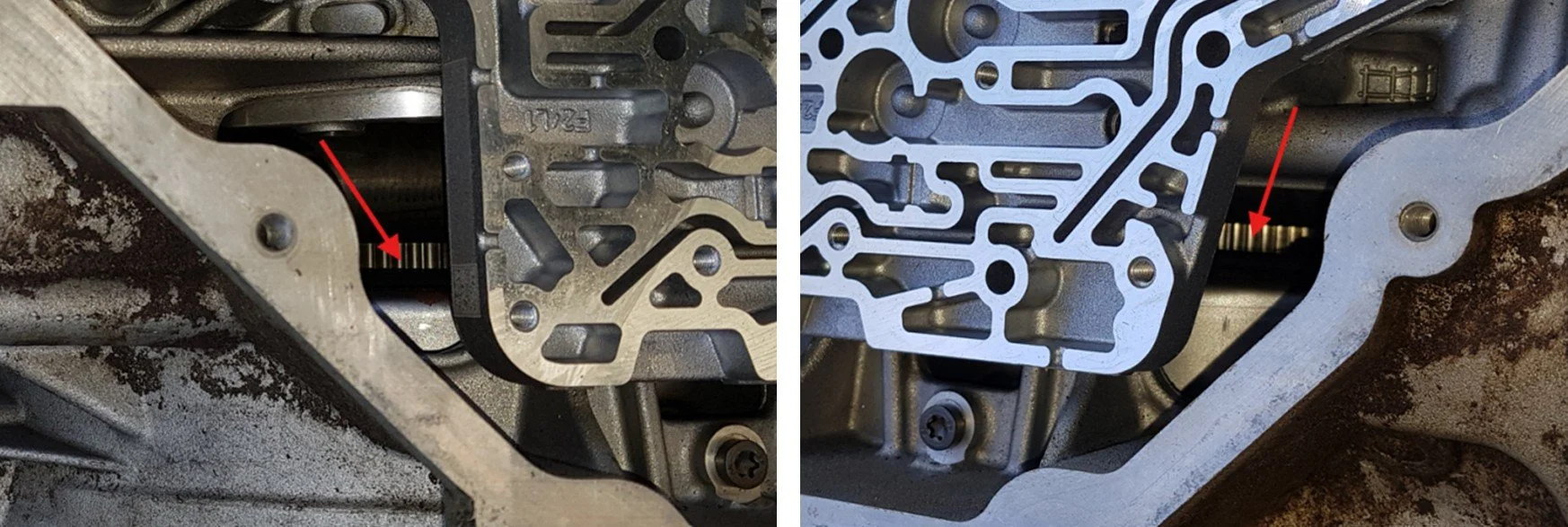
It is possible to observe the gear that engages with the clutch to see if it’s turning or not. To do this, drain the clutch fluid, remove the pan and look from underneath. Prior to this, pull the fuel pump fuse to stop the engine so it doesn’t start when you crank. Then observe the gear from below when cranking. See images below. The only time this is difficult is for the 911 with the active differential, as the small valve body that controls this being in the way. If you know what you are looking for it is still possible to see it.